

There is a puzzle in logic called the Barber’s Paradox. In a town where the barber shaves all those who do not shave themselves, who shaves the barber? The answer is that no such barber can exist, not because barbers are impossible, but because a system cannot contain, without contradiction, a complete reference to itself. The moment it tries, something breaks. Not catastrophically. Just quietly, like a door that opens onto the room it’s already in.
This is where the thinking started. Not with meditation. Not with philosophy of mind. With a paradox about a barber. Something in that structure felt important before it was possible to say why.
Gödel formalized the same intuition in 1931. Any formal system powerful enough to describe arithmetic cannot prove its own consistency from within itself. This is not a flaw in the system. It is a structural feature of what it means to be inside something. The outside view, the view that would complete the picture, is not available from within the picture. You can extend the system, add new axioms, climb to a higher level of abstraction. But the new level will have the same problem. The horizon moves with you. It always will.
Most people encounter this result as a curiosity about mathematics and move on. But pull on it long enough and it stops feeling like a theorem and starts feeling like a description of something fundamental about what it means to be located anywhere at all.
Before any of this was philosophy, it was ego.
The story of the self is remarkably totalizing when you are living entirely inside it. Not maliciously; just completely. The self and its narrative occupy the available space so thoroughly that the idea of something outside them doesn’t register as a possibility. It isn’t denied. It simply doesn’t arise. The eye cannot see itself. Not because it lacks the capacity, but because seeing is what it is; it cannot step outside its own function to observe that function from elsewhere.
This is not a flaw. It is the mechanism working exactly as it must.
But there are moments when the mechanism pauses. When the story briefly stops generating itself. And in that pause, something else becomes available; not as a new thought, but as the absence of the structure that was producing thoughts. What remains in that absence is difficult to describe without immediately falsifying it. Language is a tool of the story. It works by placing things in relation to other things, by naming and locating and sequencing. What is encountered in the pause is prior to all of that.
The best available word is peace. Not happiness; happiness needs contrast, needs the memory of unhappiness to know itself. Not nothing; nothing is still a concept, still something the mind produces. Not everything; everything is just nothing with the signs reversed. Peace is the closest, because peace doesn’t require a referent. It simply is what is there when the requiring stops.
Complete, but without edges. Non-existent, but not absent. No story. No placement. No conflict. Not death. Not void in the sense of emptiness; void in the sense of a space without constraints.
The negative associations around void come from reading it through the lens of selfhood. If the self is what matters fundamentally, its dissolution must be loss, even death. But that reading assumes the self is the ground rather than something that arises from the ground. The experience suggests otherwise. The self is not what gets lost. It is what the ground wears in order to have the particular kind of experience that requires location, sequence, and edge.
This is where the formal and the experiential unexpectedly converge.
Gödel’s result, relativistic locality, and the hard problem of consciousness are three separate domains of inquiry, but they produce the same structural shape. A system that cannot close on itself. An observer who cannot access the whole from any position within it. An explanatory gap between the third-person description of a process and the first-person fact of what it is like to undergo that process. These are usually treated as three separate problems. The argument here is that they are the same problem, seen from different angles.
Recurrence across domains is not proof. It does not collapse mathematics, physics, consciousness, and lived experience into one solved metaphysic. But it does make a pattern harder to dismiss. When the same structural limitation keeps appearing in places that should be different enough to matter, it stops looking like a clever analogy and starts looking like something worth taking seriously. Not certainty. Not revelation. A candidate structural principle of situated existence. A shape that has survived enough translation to earn investigation.
Call the ground, the non-dual, self-present, phenomenal source from which both experience and structure arise, the Foundational Singularity. Not God in the personal sense. Not the universe in the mechanistic sense. Something prior to that distinction: the fact of there being something rather than nothing, and that something being, at its root, experiential rather than merely physical.
Call the constraint architecture, the logical, causal, and informational boundaries within which located experience becomes possible, the Imposed Tangibility Grid. This includes the finite speed of light, which prevents any observer from accessing the whole simultaneously. It includes the logical non-closure that prevents any system from certifying itself completely. It includes the explanatory gap that ensures no third-person account ever fully captures what it is to be a first-person.
And call the located, bounded, narrative-generating, story-having, barber-pondering entity that arises within those constraints a Localized Subjective Instance. A self. You. The thing reading this.
The same shape appears in less abstract places too. A neuron does not know it is participating in a mind. It fires locally, responds to local conditions, and has no access to the whole it helps constitute. Yet the mind is not somewhere else. It is what emerges from the constrained interaction of parts that never possess the total view. The limitation is not incidental to the system. It is part of what allows the system to exist in the first place.
The relationship between these three is the argument.

The constraints are not the problem. They are the solution.
This is the move that feels counterintuitive at first and then, once seen, hard to unsee.
If the ground is total, if everything is already everything, if the source is already complete, then what is the point of the particular? What is the point of this life, this moment, this choice, this risk? If the answer is already known, inquiry is theater. If the outcome is already determined, agency is illusion. If the whole is already present, the part is just a confused way of pointing at what was always there.
The constraints are what make the part real. The finite speed of light means that what happens here, now, with this information, under these conditions, genuinely matters; because there is no instantaneous correction available, no global view to defer to. The logical non-closure means that the next step cannot be computed from within the current position; it must be ventured. The explanatory remainder means that no account of you, however complete, captures what it is to be you; which means your experience is irreducibly yours, not a duplicate of something that could have been instantiated elsewhere.
Uncertainty is not the enemy of meaning. It is the condition of meaning. A game in which all moves are known in advance is not a game. A story in which nothing is at stake is not a story. A life in which the ending is certain is not, in the relevant sense, a life being lived.
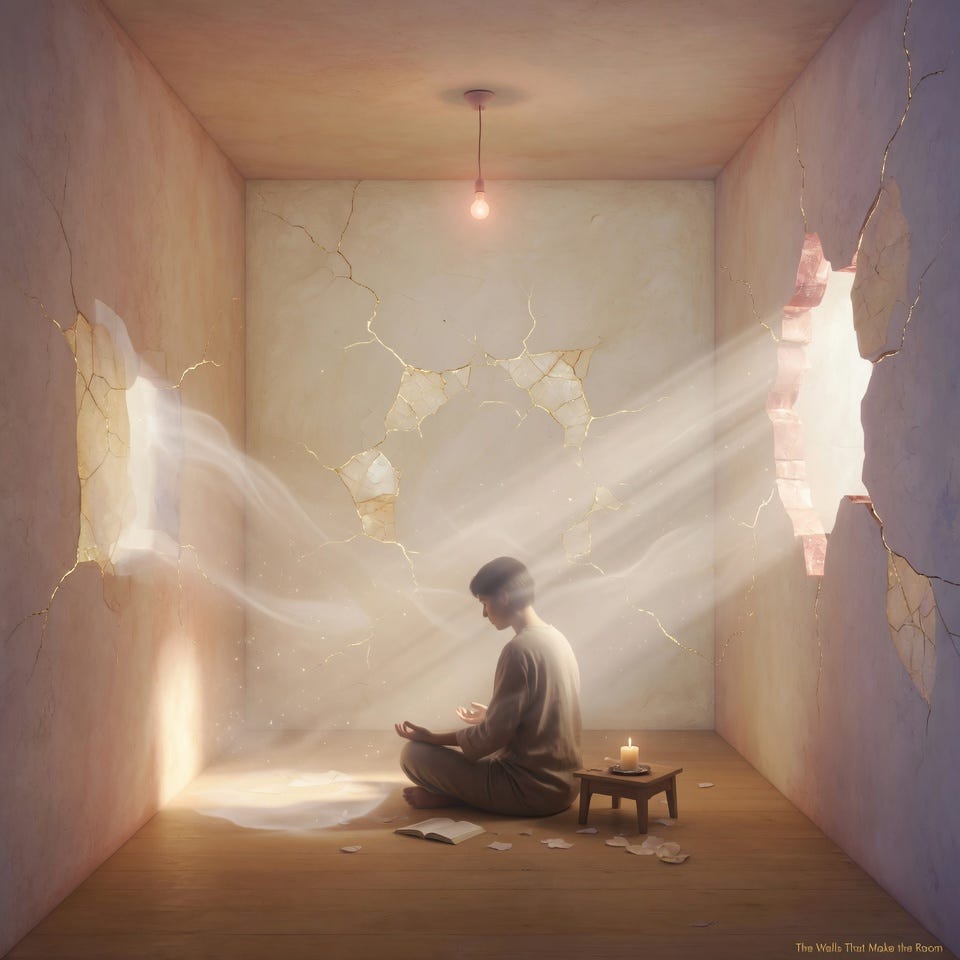
The walls make the room. The constraints make the arena. The limitations are what allow the experience of being genuinely located somewhere, genuinely facing something, genuinely able to choose and therefore to grow.
A map works the same way. The edge of the map is not necessarily the edge of reality, but it is a real edge for navigation. You cannot act beyond what your current map affords, even if more exists. The limit is epistemic, not absolute, but it still shapes what can be done from where you are. Constraint is not always the end of the world. Sometimes it is simply the condition under which orientation becomes possible at all.
A guitar string only becomes a note under tension. Constraint is not what prevents resonance. It is what makes resonance possible.
The ego is not the obstacle. It is the instrument.
This is perhaps the hardest thing to say clearly without being misread. The dissolution of ego is not the goal. The ego, the story, the narrative self, the located point of view with its history and preferences and stakes, is the mechanism by which the ground experiences the particular. Without it, there is peace, yes. But there is no learning. No risk. No genuine encounter. The void is the ground, not the destination.
What changes, after the pause, is not that the ego disappears. It is that the ego loses its status as the only available reality. It becomes visible as a structure rather than simply being the structure within which everything else is visible. The story continues, but you are no longer entirely identical with it. There is some small distance; not detachment, not indifference, but the capacity to hold the story lightly enough to notice that it is a story.
And that’s okay.
Those three words carry more weight than they appear to. They are not resignation. They are not the spiritual bypass of pretending difficulty isn’t difficult. They are the recognition that being a located, limited, story-having, ego-driven, sometimes-confused agent in an arena that doesn’t bend to preference is not a mistake. It is the point. The limitation is not what we are trapped in. It is what we are made of, in order to be made at all.
The hard problem of consciousness, why there is something it is like to be a subject, why the lights are on, has resisted every attempt at solution because every attempt tries to derive the first-person from the third-person. To explain the inside from the outside. This is the barber’s problem again. The system cannot contain a complete account of its own interiority because the interiority is what’s doing the containing.
The move that makes more sense is not to solve the problem but to invert the question. Not: how does matter produce mind? But: how does an intrinsically experiential ground produce the stable, shareable, apparently mind-external structure we call the physical world?
That question doesn’t have a final answer either. But it has the right shape. It starts from the one thing that is indubitable; that there is experience, that the lights are on, that something is happening from the inside; and asks how the rest follows. Rather than starting from the outside and trying to explain the inside into existence.
The inside was always primary. The outside is the shape it takes when it wants to encounter itself.
Religion has known something true and said it badly. Science has described something true and missed what it’s describing. The intuition behind religious experience, that there is something more fundamental than the material, that the self participates in something larger than itself, that peace is available and is not nothing, is not wrong. The demand that this intuition be housed in specific narratives, specific beings, specific instructions, is where the trouble starts.
The materialist dismissal of that intuition, consciousness is just neurons, the self is an illusion, the peace of meditation is just parasympathetic activation, is not wrong about the mechanisms. It is wrong about what the mechanisms are mechanisms of.
The ground is real. The constraints are real. The located self that arises within them is real. The peace that becomes available when the self briefly releases its grip on being the whole story is real. None of these require each other’s dismissal.
We are the source, limited in our ability to experience it. So we found a way. The limitation is the finding. The walls are the room. The constraint is the gift.
The barber can’t shave himself. The system can’t prove itself. The eye can’t see itself. And in that necessary blindspot, something gets to exist that couldn’t exist otherwise.
You. Here. Now. Not knowing the ending. That’s the whole design.
References
Shank, J. (2026). The Case for Collective Consciousness. https://philpapers.org/rec/SHATCC-12