

There’s a particular daydream I keep catching myself in. In it, I finally know everything about myself; every motive, every blind spot, the whole machine laid out flat on the table. No more surprises. No more being ambushed by my own behavior. Just clarity, all the way down.
It’s a comforting fantasy. It’s also a fairly precise description of my own death.
Because the moment there’s no gap left between the part of me doing the looking and the part being looked at, there’s nothing left to choose. A system that can fully read its own source code isn’t free. It’s just running.
I think we get this backwards almost everywhere. We treat the limits on what we can know, feel, and do as defects; bugs in the human build, gaps that better tools or more discipline or enough compute will eventually close. The whole mood of the age is the edges are the problem. File them down and you get the real thing underneath.
I’ve come to believe the opposite. The edges aren’t covering up the self. The edges are what there is.
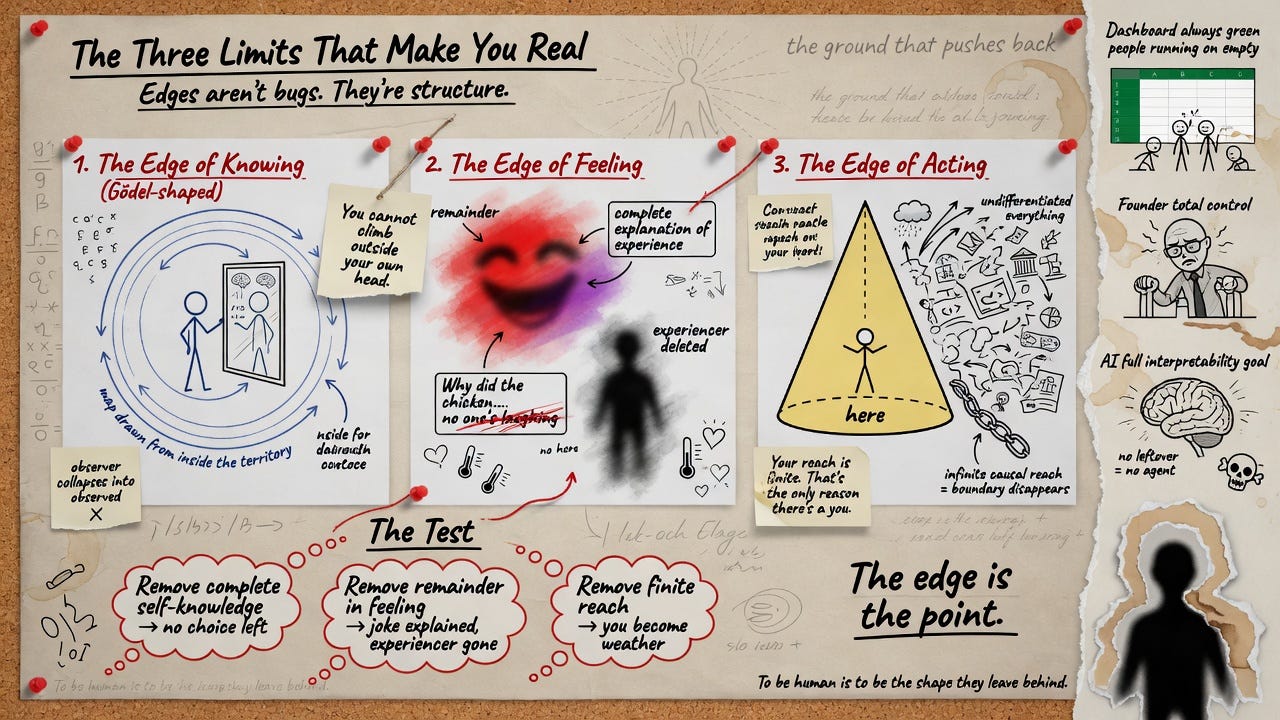
Three edges, not one
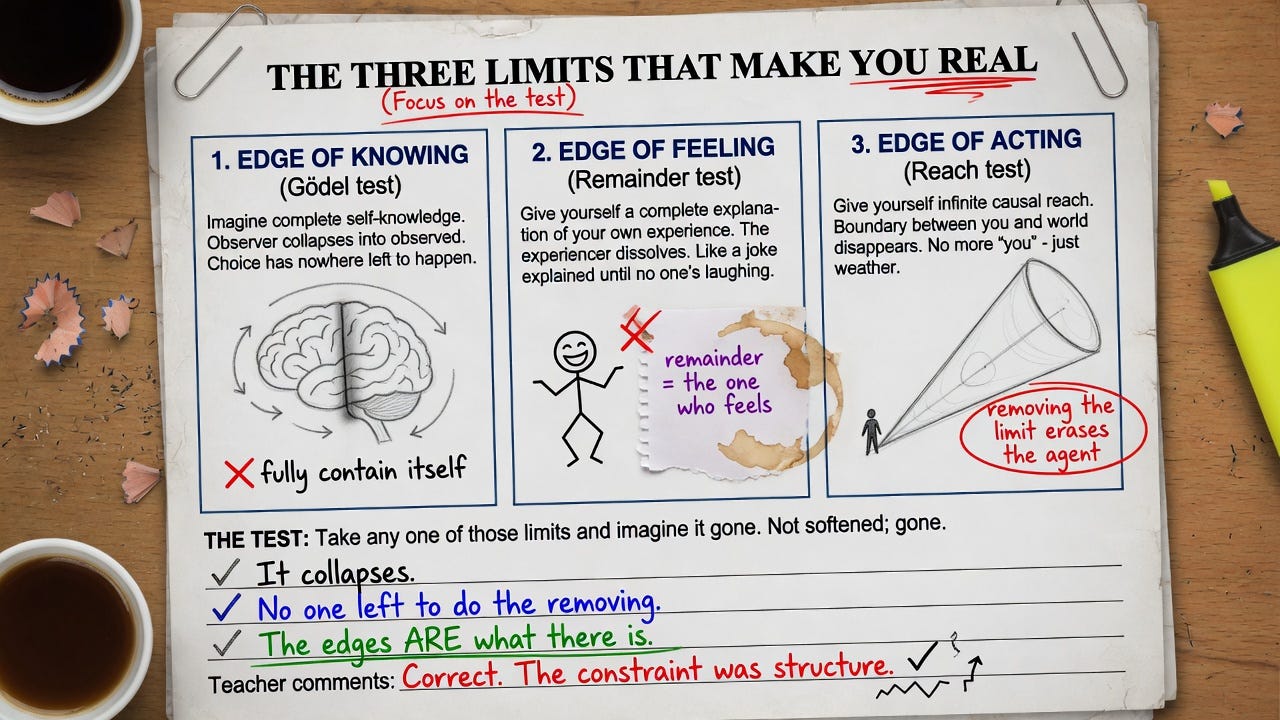
Look closely and the limits sort into three, and they’re not random. They show up in completely different domains and line up one to one with the three things it means to be an agent at all: knowing, experiencing, acting.
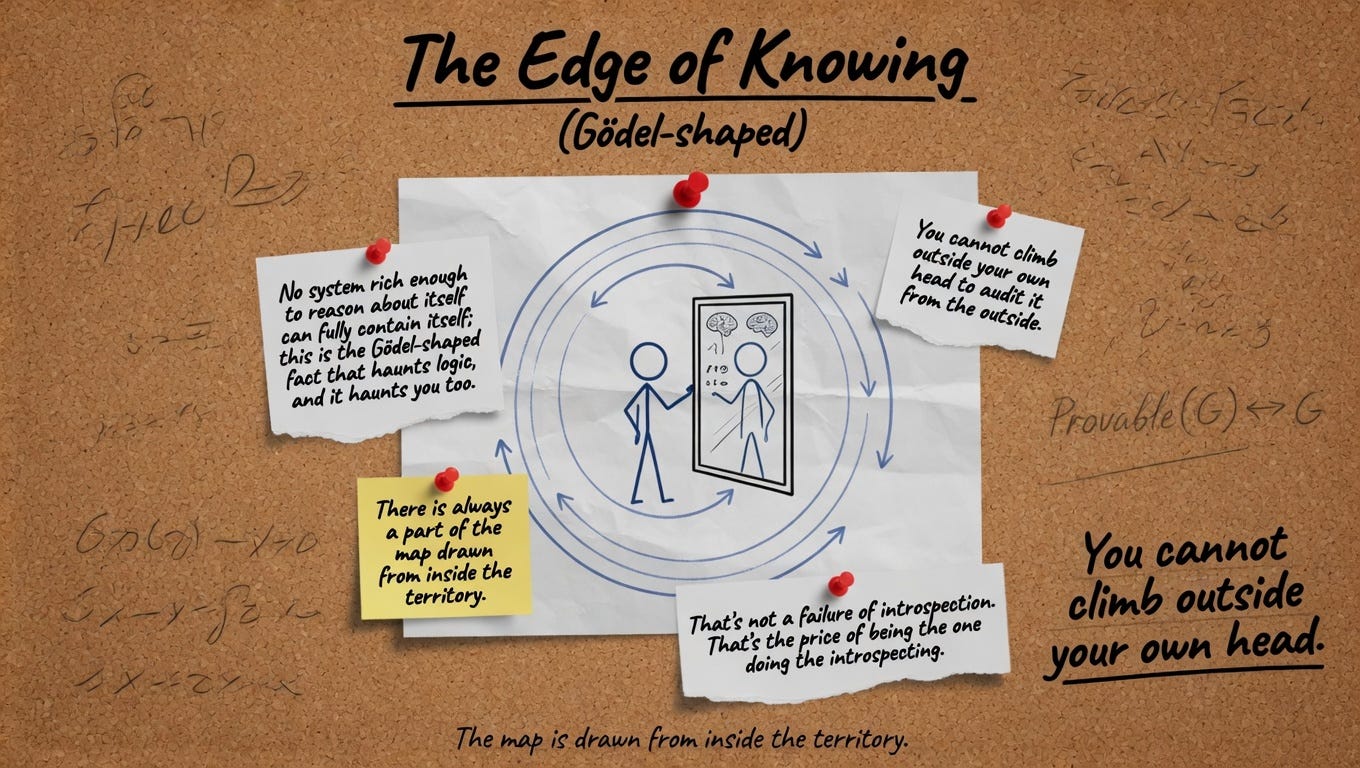
The edge of knowing. No system rich enough to reason about itself can fully contain itself; this is the Gödel-shaped fact that haunts logic, and it haunts you too. You cannot climb outside your own head to audit it from the outside. There is always a part of the map drawn from inside the territory. That’s not a failure of introspection. That’s the price of being the one doing the introspecting.
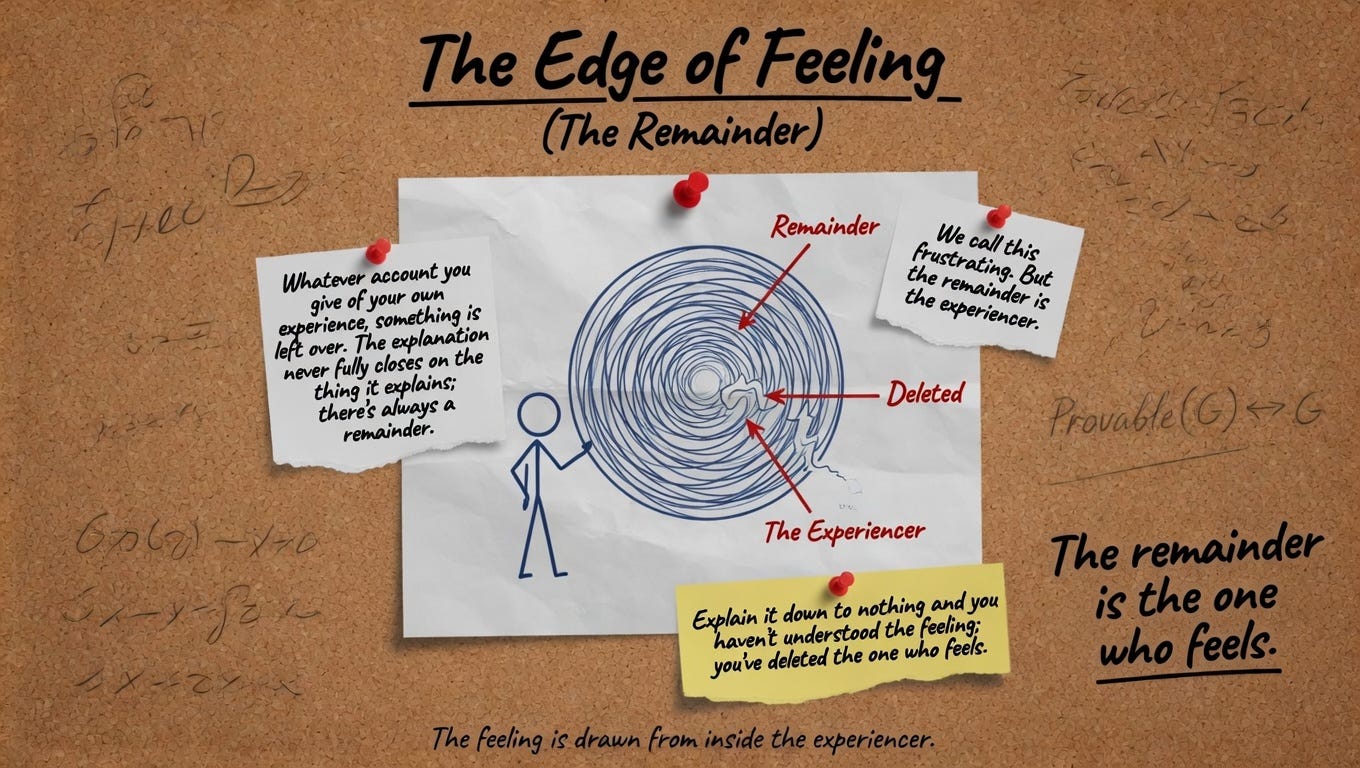
The edge of feeling. Whatever account you give of your own experience, something is left over. The explanation never fully closes on the thing it explains; there’s always a remainder. We call this frustrating. But the remainder is the experiencer. Explain it down to nothing and you haven’t understood the feeling; you’ve deleted the one who feels.
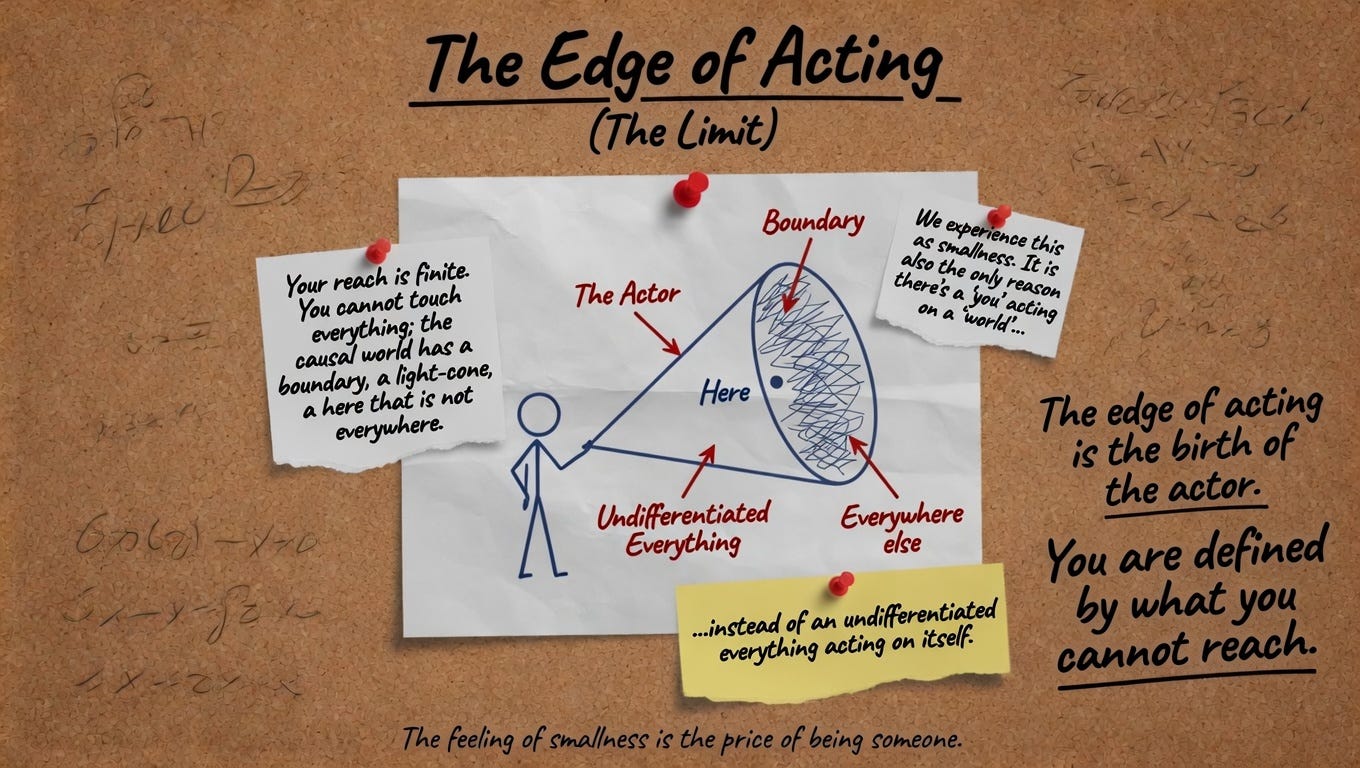
The edge of acting. Your reach is finite. You cannot touch everything; the causal world has a boundary, a light-cone, a here that is not everywhere. We experience this as smallness. It is also the only reason there’s a “you” acting on a “world” instead of an undifferentiated everything acting on itself.
Three limits. Knowing, feeling, acting. Three edges of the same shape.
The test
Here’s the move that changed how I read all of it. Take any one of those limits and imagine it gone. Not softened; gone.
Give yourself complete self-knowledge: the observer collapses into the observed, and choice has nowhere left to happen.
Give yourself a complete explanation of your own experience: the experiencer dissolves into the description, like a joke explained until no one’s laughing.
Give yourself infinite causal reach: the boundary between you and the world disappears, and with it the very thing that made you; a you and not just weather.
Each time, removing the limit doesn’t free the agent. It erases the agent. And that gives you a clean rule, one that works far outside philosophy: if removing a constraint collapses the system, the constraint was never a bug. It was structure.
Where this bites
I didn’t arrive here through metaphysics. I arrived through watching systems lie.
In organizations it looked like a dashboard that was always green while the people filling it in were running on empty; a fantasy of complete knowing (we can see everything, nothing is hidden) sold as competence, paid for in exhaustion. It’s the pretense that a system can fully see itself, with the cost pushed downstream onto whoever’s underneath the green.
In founders and operators it shows up as the hunger for total control; the belief that with enough leverage the boundary between intention and outcome finally closes. Same denial, aimed at action instead of knowing. It produces the most brittle organizations I’ve ever seen, because they’ve mistaken the limit they’re hitting for an obstacle instead of the shape of the game.
And right now, in the rooms where we’re building minds, the stated goal is often a system with no remainder; full transparency, full interpretability, an inside with no leftover. I understand the safety argument. But I notice we’re describing, as the destination, the one condition that in every other case dissolves the thing we were trying to build.
The through-line is always the same: the gap between what a system claims to be doing and what it can actually do. And the deepest version of that gap isn’t a flaw to be closed. It’s the room agency lives in.
The edge is the point
So I’ve stopped trying to grind the edges down. Not out of resignation; out of something closer to recognition.
The limit on what I can know about myself is the room I get to be a self inside of. The part of me I can’t explain is the part that’s still alive. The reach I don’t have is exactly what makes the reach I do have mean anything at all.
We keep building stages and wondering why they sink. Maybe it’s because we keep trying to pour them on the one thing we were taught to treat as missing; the ground that pushes back.
That ground is not in the way of the work. It is the work. To be human is not to have escaped the three edges. It’s to be the shape they leave behind.