

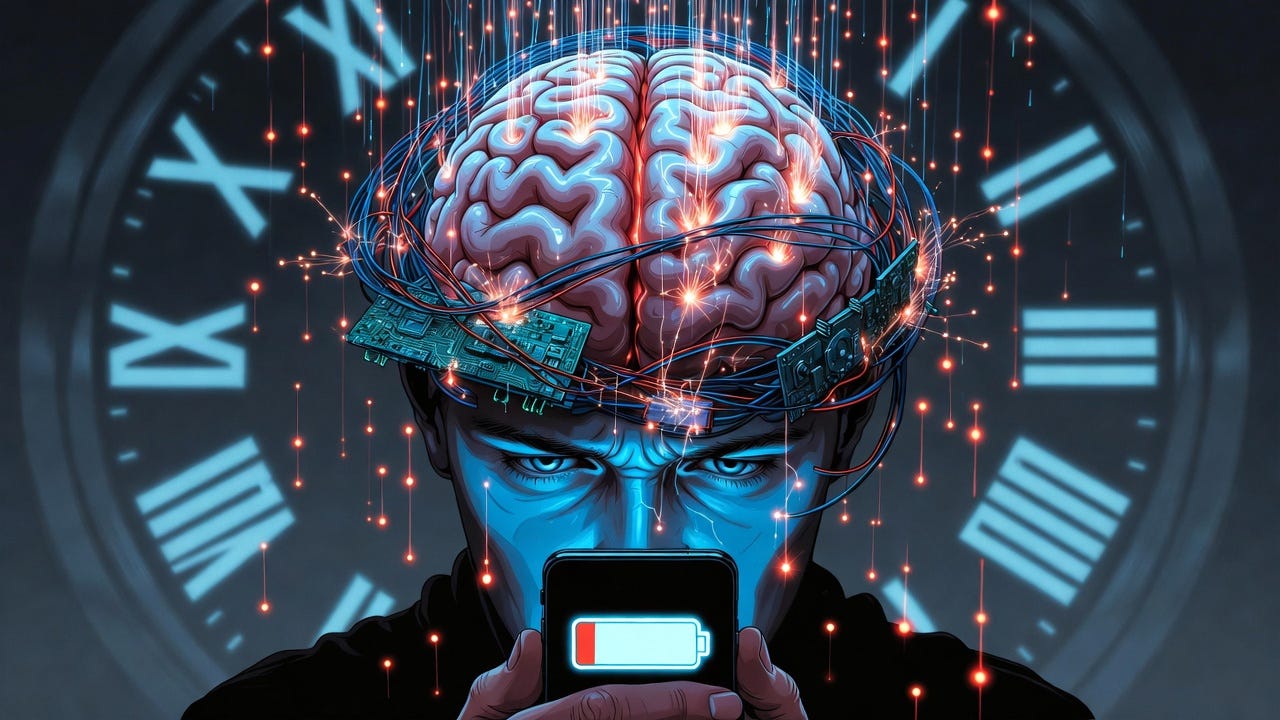
The Exhaustion You Can’t Quite Name
The canonical edition of this piece lives at shankstrategy.com.
That familiar, subtle flicker of anxiety when your phone battery dips below 20 percent, or the phantom vibration you feel in your pocket when your device is nowhere near you, is more than a modern quirk. It is a biological signal—a perfectly logical, neuro-pathophysiological response to a digital world designed to keep your attention in a state of perpetual, low-grade arousal.
The “constant hum of notification streams” has created a reality where technology moves at a velocity our biology simply wasn’t built to sustain. This feeling of being “busy but unproductive” is not a personal failure; it is a biological reality precipitated by a structural divergence between the temporal requirements of human neurobiology and the operational speeds of global information networks. Our digital world is running faster than our brains can process, and we are paying the difference in a silent, compounding “latency tax.”
The 300ms Budget - Why Your Brain is Falling Behind the Machine
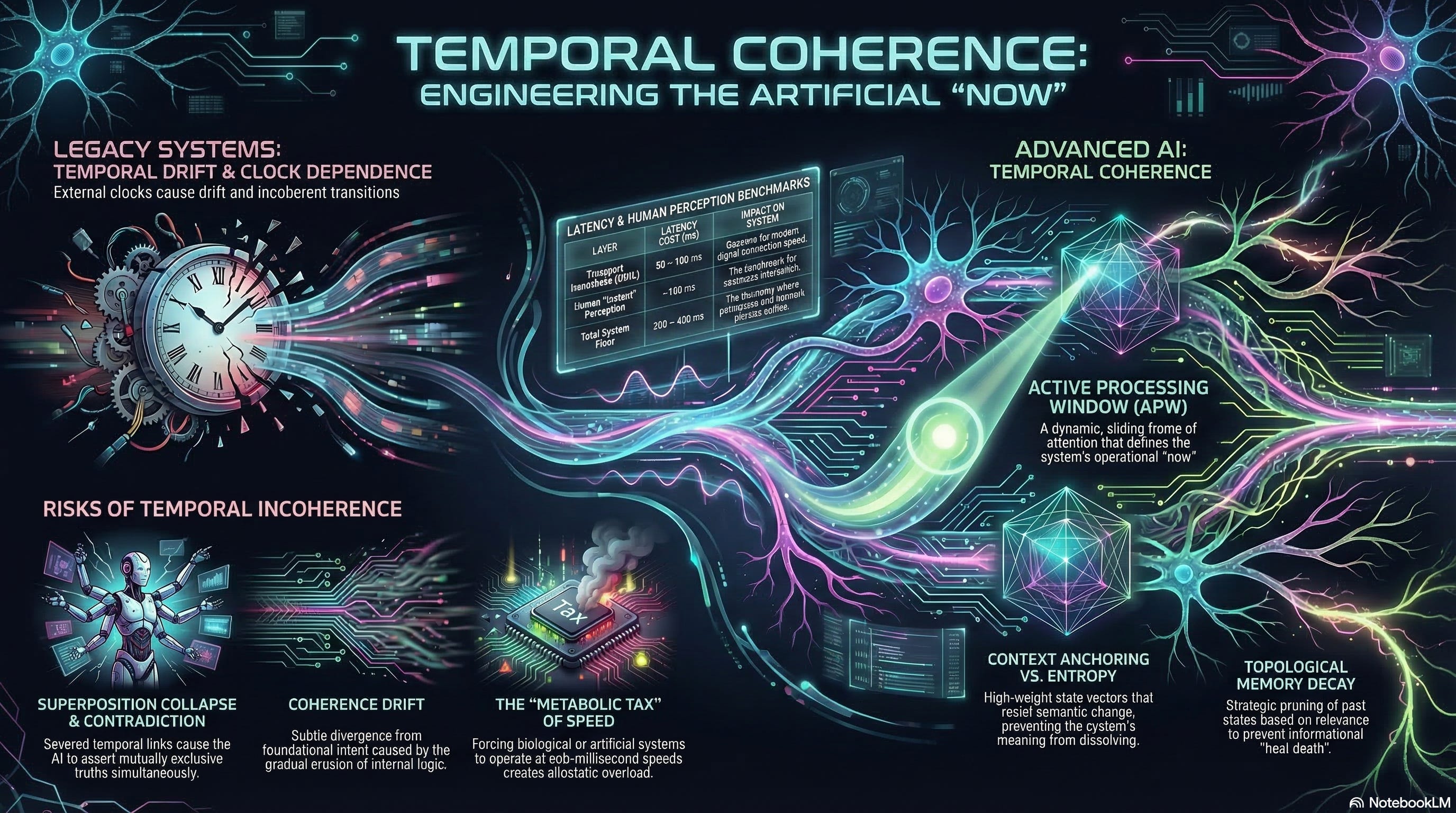
In the pursuit of ultra-low latency, modern digital protocols like QUIC, Media over QUIC (MoQ), and 5G have established a physical “floor” for response times. This is governed by the Physics of the Budget, where every millisecond consumed by network transit or protocol overhead is a scarce resource competing for space within the window of human perception. Traditional systems (HLS over TCP) once operated with a first-frame delay of roughly 370ms, but modern 0-RTT (Zero Round-Trip Time) handshakes aim for 100ms or less—effectively hitting the boundary of “instant” human perception.
However, a profound disparity exists between hardware and the human “biological clock.” While modern Dynamic Vision Sensors (DVS) achieve microsecond-level latency, the brain operates on a much slower timescale of synaptic transmission. We can see this in the Auditory Brainstem Response (ABR) benchmarks: it takes approximately 0.92ms just for a signal to reach the auditory nerve (Wave I), and up to 6.05ms to propagate to the medial geniculate body (Wave VI). This “interpeak latency” represents a biological checkpoint that machines simply bypass.
When we force the brain to synchronize with machines that operate at sub-millisecond speeds, we create “prediction errors” that the brain must resolve using metabolically expensive resources. The “hidden” latency of modern systems isn’t just network physics; it is the compute-intensive load of ML Ranking and Personalization Engines.
The Technical Latency Budget: Breakdown of System Floors
Constraint Layer
Latency Cost (ms)
Primary Driver
Network Physics
30 - 70
Speed of light in fiber (Regional RTT)
Transport Handshake
50 - 100
TCP 3-way + TLS 1.3 (2 RTT min)
Personalization Engine
50 - 100
ML Ranking + Feature Store lookups
Hardware Decoding
20 - 50
Client-side GPU/CPU processing
Total System Floor
200 - 420
Boundary of “Instant” Perception
“The pursuit of ultra-low latency in consumer and industrial platforms has established a physical ‘floor’ for globally distributed systems... where every millisecond consumed by network transit, transport handshakes, or protocol overhead is a scarce resource competing for space within the window of human perception.”
The Hippocampal Bypass - Trading Wisdom for “System 1” Reflexes
Between a stimulus and our response lies a critical “reflective gap”—a biological refractory period where raw data is converted into knowledge and impulse is subjected to reason. The architecture of modern digital interfaces is explicitly designed to collapse this gap, altering the literal routing of information through the brain.
The Bypass: Deep learning and memory consolidation require the Hippocampus, a slower-moving structure that stitches new data into existing mental models. High-velocity, emotionally charged digital stimuli skip this structure entirely, routing instead to primitive centers: the Amygdala (threat-detection) and the Striatum (reward). We react to everything but encode almost nothing.
System 1 Dominance: Human thought is divided into System 1 (fast, automatic, emotional) and System 2 (slow, analytical, logical). Digital interfaces demand instant opinions, forcing us to rely on automatic reflexes. Logic and skepticism (System 2) require “latency to boot up,” and current digital speeds starve them of the time needed to activate.
The Death of Nuance: Because attention “doesn’t shift cleanly” in a high-speed state, we suffer from “attentional residue.” This leads to fragmented encoding and the “escape latency” measured in memory tasks—a mental fog where it takes longer to find “targets” or solve complex problems because the hippocampal buffer is saturated.
The Metabolic Tax: The High Cost of the Digital Ping
The brain is a metabolically expensive organ, consuming 20% of the body’s energy despite being only 2% of its mass. Every notification, ping, or red dot is a “tiny tax” that consumes glucose and depletes the prefrontal cortex. However, the true cost is thermodynamic.
Resolving the “prediction errors” caused by digital interruptions requires a surge in ATP production. This high-intensity energy conversion incurs a cost: Reactive Oxygen Species (ROS) leakage. Superoxide anions (O2-) leak from the mitochondrial electron transport chain, causing oxidative stress and “weathering”—the premature biological aging of neural infrastructure. This transition from Allostatic Load (adaptation) to Allostatic Overload (failure) is why we feel exhausted; our “operating temperature” is being pushed beyond homeostatic stability.
The Thermodynamic Cost of Digital Interaction
Activity Type
Entropy Level*
Metabolic Cost
Neuro-Chemical Profile
Offline Deep Work
Low (Ordered)
Efficient/Sustainable
High Acetylcholine; Low Cortisol
Social Media
High (Unpredictable)
High (ROS Leakage)
Dopamine Spikes; High Cortisol
Task-Switching
Extreme (Chaotic)
Allostatic Overload
Elevated Norepinephrine
*Note: High Entropy environments are engineered for novelty and unpredictability, forcing the brain’s “prediction machine” to work harder to resolve surprise.
The Digital Twin Dilemma: Offloading or Overloading?
To manage the complexity of modern smart products—such as Volvo’s electric, interconnected vehicles—industry is turning to Interactive Digital Twins (IDTs) and “Digital Cockpits.” These systems utilize a “Digital Shadow”—a precise data subset required for a specific task—to provide real-time virtual replicas.
While this “Human-in-the-Loop” (HITL) approach can offload cognitive load by simulating future events, it presents a neurological dilemma. Based on the Bayesian brain hypothesis, our brains are constantly generating models to minimize surprise. When an IDT or cockpit violates these internal “predictions”—perhaps through a subtle sync lag or interface inconsistency—it triggers a massive “prediction error” signal. This causes a surge in ATP demand and subsequent ROS leakage, meaning the very tool designed to help us may be increasing our metabolic tax if the synchronization isn’t perfect.
The Default Mode Network Under Siege
The Default Mode Network (DMN) is the brain’s “background processor,” activating during “wakeful rest”—moments like staring out a window or walking without a podcast. The DMN is responsible for self-reflection, imagination, and synthesizing complex ideas into breakthroughs.
By filling every “micro-moment” of idle time with a screen, we chronically suppress the DMN. This systematic deprivation starves the subconscious of the silence it needs to solve hard problems. We lose our “internal narrative” and identity coherence, replacing original thought with a reactive state of “perpetual readiness” that induces cognitive rigidity.
Reclaiming the Engine - Rebuilding Your Neuro-Metabolic Machinery
Recovering from digital erosion requires more than “sleep hygiene”; it requires a phased approach to rebuilding the brain’s metabolic machinery and stopping “energy leaks.”
Phase 1: Stabilization (Months 1-3) The goal is to stop the metabolic tax using the SRM-II-5 (Social Rhythm Metric). By anchoring five specific points, we entrain the suprachiasmatic nucleus (SCN):
Out of Bed: Retinal light resets the cortisol awakening response.
First Contact: This social interaction is a cortical arousal signal that terminates melatonin production and initiates the waking metabolic cascade.
Start of Activity: Defines the energy-spending phase to reduce decision fatigue.
Dinner: Entrains peripheral clocks in the liver and gut.
Into Bed: Initiates the restorative phase.
Phase 2: Capacity Building (Months 4-6) Utilize Zone 2 Training (60-70% max heart rate) for 45-90 minutes, 3-4 times per week. This stimulates mitochondrial biogenesis—literally creating new “energy factories” to handle cognitive demand and improve metabolic flexibility.
Phase 3: High Performance (Months 6+) Re-engaging with “Deep Work” only after the hippocampal buffers have been restored and the DMN has been stabilized.
“The brain, a highly metabolically expensive organ, requires consistent ATP production to maintain executive function and emotional regulation.”
Conclusion - The Adelic Handshake
To survive the velocity of the 21st century, we must move toward the Adelic Handshake—a future where the discrete digital world and the continuous biological world are perfectly synced. We must transition from being passive recipients of digital stimuli to being active managers of our own neurological state, demanding digital architectures that respect the “Physics of the Budget” not just for speed, but for cognitive compatibility.
In a world designed to move at the speed of light, are you brave enough to demand the latency your soul requires to think? What’s your latency tax story?