

TL;DR
Humanity’s quest to externalize knowledge began with cave paintings 40k years ago; the first “upload” of models for survival. We’ve compressed reality through art, language, math, and now AI, which makes intelligence abundant and shifts bottlenecks from muscles to brains to energy (Joules). AI excels at “how” but needs human “what”; intent, curiosity, judgment: to drive discovery via productive errors. In the Age of Joules, we steer the future by choosing what matters.
I. The First Upload
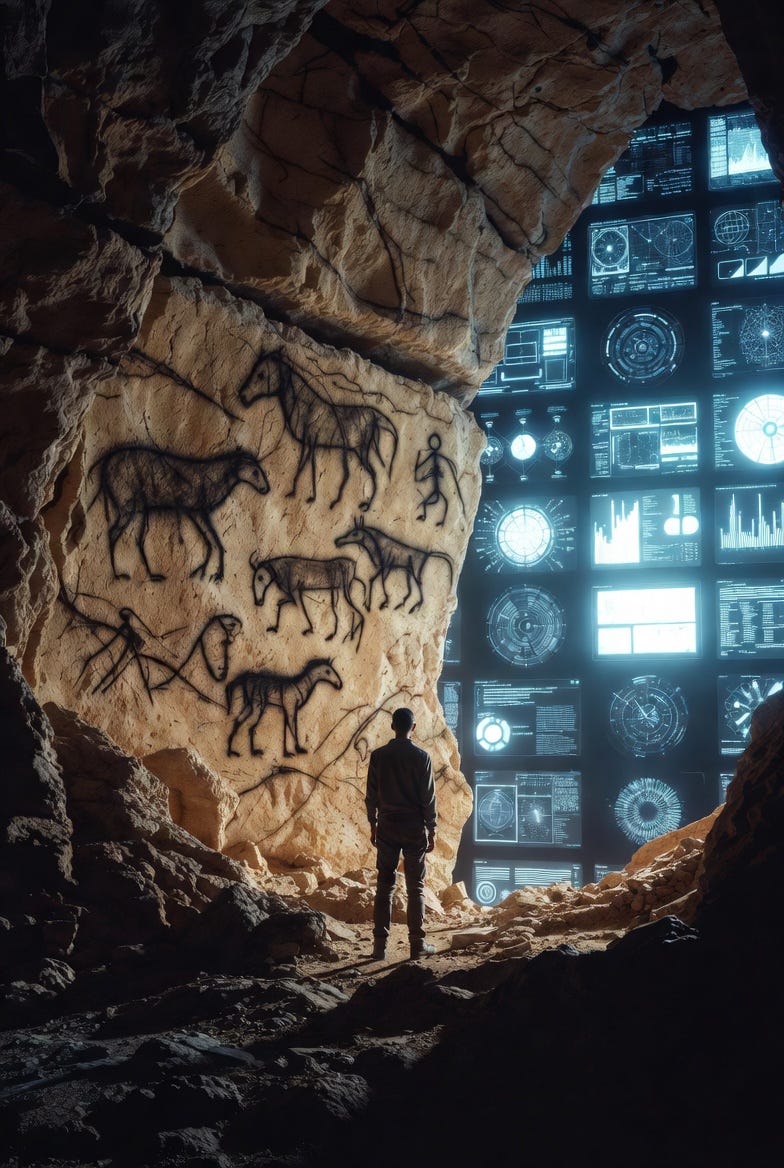
Forty thousand years ago, deep in the limestone caves of what is now southern France and northern Spain, a human being did something that no other creature on Earth had ever done. By the guttering light of a tallow lamp, they pressed a piece of charred bone against the wall and drew a bison.
To a casual observer traveling back in time, it might look like decoration. Art for art’s sake. A moment of leisure in an otherwise brutal existence. But that interpretation would miss something profound; something that, once you see it, you cannot unsee in everything that has come after.
That person wasn’t decorating. They were uploading.
Think about what the act of drawing actually requires. You have to observe the animal with enough precision to reconstruct it. You have to abstract away everything irrelevant; the smell of the grass, the sound of hooves on frozen ground, the cold; and keep only what matters strategically: the shape of the body, the direction of movement, the position of the vulnerable flank. You have to compress a living, three-dimensional, terrifying creature into two dimensions of charcoal and ochre. And then you have to fix it to a surface that will outlast you.
That is not decoration. That is modeling. It is the construction of an external representation of an internal understanding. And it changed everything.
Before that moment, every piece of knowledge a human being possessed existed in one place: inside their skull. When they died, it died with them. The next generation had to relearn the patterns of the herd, the location of the watering hole, the best angle of attack. Every life began, in a sense, from scratch.
The cave painting broke that constraint. For the first time, an idea could survive its thinker. It could be shared across a group, studied by strangers, and used by children who had never seen the original animal. The cave wall was humanity’s first hard drive; not metaphorically, but functionally. It was an external substrate for storing and transmitting strategic information.
We have been building on that invention ever since. Every clay tablet, every manuscript, every equation scrawled on a blackboard, every line of code compiled on a server in a Virginia data center; all of it is the same fundamental act, grown more powerful and precise over millennia. We are obsessed, as a species, with taking what lives inside our heads and moving it somewhere more durable, more shareable, and more capable.
Artificial Intelligence is not a rupture in this story. It is its culmination. But to understand why, and to understand what it means for the world we are about to inhabit, we have to trace the full arc; from the cave wall to the cloud, and through to whatever comes next.
Because something genuinely new is happening. Not just technologically, but economically and philosophically. The rules that have governed human civilization for centuries are quietly being rewritten, and most of us are not paying close enough attention to notice.
II. The History of Compression: Making the World Fit in Our Hands
There is a word that sits at the heart of this entire story, and it is not intelligence or technology or even progress. It is compression.
The world, in its raw form, is incomprehensible. Not because we are stupid, but because reality generates more information per second than any biological mind can possibly process. The wind moving across a wheat field. The temperature gradient in a river. The social dynamics of a tribe of two hundred people. The likely behavior of a herd of bison in the next valley. All of it is happening simultaneously, at a level of detail that would overwhelm any system trying to model it completely.
Survival, then, required a shortcut. It required finding ways to represent the essential features of the world in a form compact enough to think with. A map is not the territory; but that is precisely what makes it useful. The map strips away the individual blades of grass and the temperature of the soil so that you can see the one thing that actually matters: the path.
This is compression. And it is the central technology of human civilization.
From Art to Algebra
The cave painting was our first deliberate compression algorithm. But it had limitations. It was analog, approximate, and deeply tied to the specific. A painting of a bison tells you about that bison, in that posture, in that moment. Generalizing from it required the human mind to do additional work.
Over millennia, we invented more powerful compression tools. Language allowed us to compress not just images but relationships and causality. “The bison moves south when the cold comes” is a more powerful piece of knowledge than any painting, because it encodes a rule rather than an instance.
Then came mathematics; and this is where compression became something almost magical.
An equation is not just a description of a thing; it is a description of a process. Consider the class of tools that mathematicians call Partial Differential Equations, or PDEs. They are some of the most abstract and intimidating objects in all of science, but their purpose is almost poetic in its simplicity: they are recipes for predicting how the world changes from one moment to the next.
The equations that describe how heat moves through a metal rod, how air flows over the wing of an aircraft, how a disease spreads through a population; all of them are PDEs. What they have in common is that they take the bewildering complexity of a physical process and reduce it to a relationship between a handful of measurable quantities. You don’t have to simulate every molecule of air to predict whether a wing will generate lift. You just have to know the right equation.
This is compression taken to its extreme: the “source code” of physical reality, written in a language compact enough to fit on a single page.
Every scientific and engineering advance of the past three centuries rests on this foundation. We did not conquer infectious disease by watching every bacterium; we built compressed models of how diseases spread and intervened at the level of the model. We did not put satellites in orbit by physically testing every possible trajectory; we solved equations that predicted where every object would be at every moment. The physical world is extraordinarily complex. The mathematical models we built of it are extraordinarily compact. And that gap; between the complexity of reality and the compactness of our models; is where all of civilization’s leverage lives.
The Silicon Leap
For most of human history, these models shared one critical limitation: they were passive. A map does not navigate itself. An equation does not solve itself. The compressed representation of the world still required a human being to read it, interpret it, and decide what to do with it.
This is the constraint that artificial intelligence, in its modern form, has broken.
A neural network; the architecture that underlies the AI systems you encounter today; is best understood as a new kind of model. It is trained on enormous quantities of human-generated data: text, images, code, scientific papers, conversations, and everything else we have ever committed to a digital medium. Through a process of statistical learning, it builds what researchers call a “latent space”: a high-dimensional internal map of how concepts, words, and ideas relate to one another.
When you ask such a system a question, it doesn’t retrieve a pre-written answer from a database. It navigates that internal map in real time, finding a path through the space of ideas that leads from your question to a coherent response. The map executes itself. The model comes alive.
We have, in other words, crossed a threshold that no previous compression technology ever crossed. We have built models that do not merely represent understanding; they exercise it. The bison on the cave wall has stepped off the stone. It moves, it reasons, it responds. It is no longer a map of a thought. It is, in some meaningful functional sense, a thought.
This is not a small thing. And it is changing everything that follows.
III. The Great Bottleneck Shift: The Labor-Intelligence-Energy Pipeline
Civilizations, at their core, are engines for solving bottlenecks. The history of human progress is largely a history of identifying the scarce resource that is limiting growth, building tools to overcome it, and then discovering the next constraint lurking underneath.
Understanding this pattern; and recognizing where we are in it right now; may be the most practically important thing any person can do as they try to navigate the next several decades.
Phase One: The Era of Muscles
For the overwhelming majority of human history, the fundamental bottleneck was physical labor. If you wanted to build a structure, clear a field, move goods from one place to another, or wage a war, you needed human bodies: and a lot of them. The constraints of agriculture, construction, and transport were measured in arms and backs.
The Industrial Revolution did not merely make things faster. It performed a categorical transformation: it turned physical work into a commodity. The steam engine could do the work of hundreds of men without eating, sleeping, or asking for wages. Suddenly, the scarce resource was no longer human muscle. It was capital; the ability to build and deploy machines.
This unlocked an extraordinary burst of growth. But it also revealed the next constraint.
Phase Two: The Era of Brains
By the 20th century, the machines existed. The physical infrastructure was there. But someone had to tell the machines what to do, how to optimize them, how to design the next generation of them, how to apply them to new problems in medicine, chemistry, logistics, and finance. The bottleneck shifted from physical labor to cognitive labor.
This was the era of expertise. The limiting resource was the number of people who could spend twenty-five years becoming a doctor, an engineer, a research scientist, a specialized lawyer. The pipeline from ignorance to expertise was long, expensive, and slow. You couldn’t simply manufacture a new oncologist. You had to grow one, through years of education and experience, one at a time.
The entire infrastructure of modern civilization; universities, research institutions, professional licensing, graduate programs: was built to manage this bottleneck. To produce, as efficiently as possible, the cognitive labor that advanced economies needed to function.
Phase Three: The Era of Joules
We are now watching that bottleneck dissolve.
This is not a future prediction. It is a present observation. AI systems are already performing cognitive tasks; summarizing legal documents, writing functional code, diagnosing patterns in medical images, generating synthetic research hypotheses: that would have required years of specialized human training just a decade ago. The trajectory is not ambiguous: the capability of these systems is improving faster than the institutions built to produce human experts can respond.
When intelligence becomes software, it acquires the properties of software. It can be copied. It can be scaled. It can run on a thousand servers simultaneously without any one instance being degraded by the others. You do not have to wait twenty-five years for it to mature. You do not have to pay it a salary or grant it tenure. You spin up another instance.
For the first time in history, cognitive capacity is not the scarce resource.
So what is?
Follow the chain to its physical foundation. Every time an AI system processes a query, generates a response, runs a simulation, or trains on new data, it is performing computation. Computation, at its core, is the physical manipulation of electrons through silicon; transistors switching states, currents flowing, heat being generated. All of it requires energy. There is no abstraction layer that eliminates this requirement. Intelligence, when it runs on machines, runs on physics. And physics runs on power.
The final wall, the constraint that sits underneath all others once intelligence becomes abundant, is the Joule.
This is not a metaphor. The largest AI training runs today consume power equivalent to small cities. The buildout of data center infrastructure has become one of the primary drivers of electricity demand in the United States and Europe. Projections from major research institutions suggest that AI compute demand could represent a significant fraction of global electricity consumption within this decade. The companies developing frontier AI systems are not primarily competing on algorithmic cleverness anymore; they are competing on access to power, to cooling infrastructure, to land near transmission lines.
The “knowledge economy” framing that has dominated economic thinking for forty years; the idea that the most valuable thing a nation or company could possess was educated human capital; is not wrong, exactly. But it is becoming incomplete. We are transitioning, steadily and irreversibly, into an energy economy. The wealth of nations will increasingly be measured not by the size of their educated workforce, but by the reliability and abundance of their access to cheap power.
This is a significant shift in how competitive advantage works. It is also a significant shift in what it means to be valuable as an individual human being; and it points directly to the question the final sections of this essay are trying to answer.
IV. The Engine of Discovery: Why Perfection Is the Enemy of Progress
There is a temptation, when we talk about AI becoming more capable, to assume that the direction of that capability is simply toward greater accuracy. Smarter AI means fewer errors. Better AI means more reliable answers. The ideal endpoint, in this framing, is a system that is always correct.
This intuition is wrong in a way that matters enormously.
The “Average” Trap
To understand why, it helps to understand how modern AI systems are actually trained. The dominant approach involves showing a system billions of examples of human-generated content and training it to predict the most likely next word, idea, or action given what has come before. The system learns, in essence, to be the most probable thing; the center of the distribution, the statistical average of all the text and knowledge it has been trained on.
This makes current AI systems extraordinarily useful for tasks that exist within the boundaries of established human knowledge. Ask a language model to explain photosynthesis, write a contract clause, debug a function, or summarize a body of research, and it will do so with remarkable fluency; because all of these tasks exist within the mapped territory of what humans already know.
But consider a different kind of problem. Not “explain what we know about nuclear fusion”; that is retrieval and synthesis, and AI handles it well. Instead: “discover a new approach to achieving net-positive fusion energy that no human has yet conceived.”
This task is categorically different. The answer does not exist in the training data because no one has found it yet. It cannot be retrieved from the latent space because it is not in the latent space. To find it, the system would have to venture beyond the average; into territory where the existing map says nothing, or says the wrong thing. It would have to generate ideas that are, by the standards of current knowledge, wrong. And then, crucially, it would have to be capable of testing those wrong ideas to see which ones are productively wrong; wrong in ways that point toward something true.
This is the difference between optimization and discovery. Optimization is doing what we already know how to do, but better and faster. Discovery is finding something that nobody knew was possible. And the pathway to discovery almost always runs through error.
The Strength of the Flaw
Materials science offers one of the clearest illustrations of this principle anywhere in the physical world.
If you were to construct a piece of metal from a perfectly regular lattice of atoms; each atom precisely placed, no impurities, no dislocations, no gaps; you might expect the result to be extremely strong. In fact, the opposite is true. A theoretically perfect crystal is brittle. Under stress, the force propagates evenly through the entire structure until something gives way catastrophically.
Real metals; the ones we use to build bridges and aircraft and engines; derive their strength from imperfection. Dislocations in the crystal lattice, foreign atoms introduced through alloying, deliberate grain boundaries created through heat treatment: all of these are, in a precise technical sense, defects. But they are defects that do something remarkable. They interrupt the propagation of stress. They force it to dissipate. They give the material the ability to bend without breaking.
This is not an accident of engineering. It is a fundamental principle: resilience requires the productive management of imperfection. A system that is too pure, too regular, too committed to a single mode of behavior is a brittle system. Strength comes from the capacity to accommodate irregularity.
The history of scientific discovery is saturated with the same principle. Alexander Fleming did not plan to discover penicillin. He discovered it because mold contaminated a petri dish that was supposed to demonstrate something else entirely. Percy Spencer did not design the microwave oven. He discovered the cooking effect of microwave radiation because he happened to be standing near a magnetron with a chocolate bar in his pocket. In both cases, the “error”; the deviation from the planned experiment: was the discovery. The productive flaw revealed something the intentional investigation was not designed to find.
What This Means for AI - and for Us
The implication for the development of AI is significant and underappreciated. We do not need AI systems that are merely more accurate, in the sense of better at predicting the average answer. We need AI systems that are capable of structured deviation; of generating hypotheses that fall outside the distribution of established knowledge and then rigorously testing them.
This is already beginning to happen. Systems designed for scientific discovery, rather than general assistance, are being built with the capacity to propose novel hypotheses, run computational experiments, observe the results, and iterate. The AI systems that will matter most in the next decade are not the ones that can summarize our existing knowledge most fluently. They are the ones that can identify the gaps in that knowledge and explore them systematically.
One particularly compelling model for how this might work at scale involves what researchers call agent swarms: not a single AI system operating in isolation, but large numbers of AI agents working in parallel, each pursuing different approaches to the same problem, with the results of each agent’s work informing the others. The analogy to the structure of a metal is striking. Just as a composite material achieves properties that no pure substance can match; by virtue of the interfaces and irregularities between its components; a swarm of AI agents can explore a problem space far more richly than any single system, however capable.
In this model, the “productive error” is not a bug to be eliminated. It is a feature to be cultivated. The agent that stumbles onto a result nobody expected is the most valuable member of the swarm; not despite being wrong by conventional standards, but because of it.
This is an uncomfortable idea for anyone who has been trained to think of intelligence as the elimination of error. But it is a crucial one. The future of AI-driven discovery does not lie in building more confident systems. It lies in building more curious ones.
V. The Architect of Intent: What Remains When the Machine Thinks
We have come a long way from the cave wall.
We have watched the human project of externalization advance from charcoal drawings to clay tablets to mathematical equations to silicon chips to distributed neural networks running on power equivalent to small cities. At each step, we have moved more of our cognitive burden outside ourselves; made it more durable, more scalable, more capable of operating without us in the room.
And now we face a question that previous generations never had to seriously ask: when the externalized mind becomes capable enough to reason, to discover, and to act on its own: what is left for us?
This is not a question about obsolescence. It is a question about identity. And the answer, I think, is more clarifying than it is frightening.
The Shift from “How” to “What”
For the better part of three centuries, the most powerful thing a person could possess was mastery of a how. How do you design a bridge? How do you manage a portfolio? How do you perform a surgery, argue a case, synthesize a compound? The value of expertise lay precisely in the scarcity of the knowledge and skill it represented. Becoming an expert was long, hard, and expensive; and therefore the expertise itself commanded significant economic reward.
AI is in the process of compressing that scarcity. Not eliminating expertise entirely, but dramatically lowering the cost of accessing competent cognitive performance across a wide range of domains. The economic logic is straightforward: when the supply of something increases dramatically, its price falls. The price of generic cognitive labor; the “how” of familiar, well-defined tasks; is falling, and will continue to fall.
What does not compress so easily is the what.
Knowing what is worth doing is a fundamentally different kind of knowledge from knowing how to do it. It requires judgment about what matters which problems are worth solving, which values should be optimized for, which tradeoffs are acceptable. It requires the ability to ask questions that the existing framework does not suggest. It requires, in a word, intent.
Intent is not a technical capability. It cannot be derived from training data alone, because training data is a record of the past, and intent is oriented toward a possible future. You cannot predict someone’s intent from the average of what everyone else has intended before. It is, in some important sense, irreducibly individual.
This is why the cave painting metaphor completes itself here, but in an unexpected way. That early human standing in front of the limestone wall was not executing a plan. They were expressing a choice. They could have drawn anything, or drawn nothing. The act of deciding what to draw was prior to the act of drawing it; and no subsequent technology in the chain from cave wall to cloud has changed that fact. Every tool we have built, however powerful, has been in service of an intent that came from somewhere else.
As AI systems become capable of handling more and more of the “how,” the “what” becomes the primary site of human contribution. And this is, on reflection, exactly where we would want it to be. The ability to clarify what matters; to choose the problem, to specify the value, to decide what kind of future is worth building; is not a consolation prize for being replaced. It is the most important thing we have ever done. We have simply been too busy doing everything else to recognize it.
Three Capacities That Will Compound
This is not an abstract philosophical point. It has concrete implications for how any individual should think about developing themselves in a world where AI is becoming more capable.
The first is curiosity; and not as a personality trait, but as a practiced discipline. When the answers to known questions become cheap, the value shifts entirely to the quality of the questions. A person who has cultivated the habit of asking questions that the existing framework does not answer: who looks at a settled domain and wonders what the model is missing; will be extraordinarily valuable in a world of abundant intelligence. The question is the scarce resource. The ability to formulate genuinely novel questions is a skill, and like all skills it develops through deliberate practice.
The second is *judgment; the capacity to evaluate which of the many possible directions to pursue is worth pursuing. In a world where AI agent swarms can simultaneously explore thousands of hypotheses, the bottleneck is not generating the hypotheses. It is deciding which results are meaningful, which “productive errors” point toward something real, and which should be discarded. This is a kind of wisdom that requires domain knowledge, yes, but also something harder to formalize: a sense of what matters, calibrated by experience and refined by exposure to the consequences of past judgments.
The third is responsibility; and this one carries the most weight. As the capacity to act in the world scales with AI capability, so does the capacity to cause unintended harm. A system that can design a new drug with unprecedented speed can also pursue an objective with no regard for side effects, if the objective is specified carelessly. The AGI future is not dangerous because the machines will want to harm us. It is potentially dangerous because the machines will be very good at doing exactly what we ask; and we are not always sure what we actually want.
Taking responsibility for intent; being precise about what we are asking for, and honest about the values that should constrain the answer; is not a task we can delegate. It is the irreducible human contribution to the process. The AI provides the computation. The grid provides the joules. We provide the direction. And the quality of the future we build is entirely a function of the quality of that direction.
The Cave Wall, Grown to Fill the Horizon
There is something I find genuinely moving about the full arc of this story, if you step back far enough to see it.
That hunter in the cave; working by firelight, compressing their experience into charcoal on stone; was doing exactly what we are doing now. They were trying to build something that would outlast them. Something that could carry what they had learned into a future they would not see. Something that gave the next generation a better starting point than they had.
Every generation since has done the same thing, with better tools. The tools are now so powerful that they threaten to become the main actors in the story; to run ahead of us, out of our sight, pursuing futures we did not quite specify.
Which is why the question of intent is not a luxury. It is not a philosophical indulgence for people who have already solved the practical problems. It is the most practical thing of all.
The cave wall has not disappeared. It has grown to encompass the entire horizon. The tools we have built are extraordinary. The models are more precise and more powerful than anything any previous generation could have imagined. The energy to run them is, increasingly, available at scale.
What remains is the same thing it has always been: the human being standing in front of the wall, deciding what to draw.
That is not a diminished role. It is the only role that has ever mattered.
The Age of Joules is not a future to be feared or merely managed. It is an invitation; to think more clearly about what we value, to ask better questions, and to take seriously the responsibility of being the species that, alone among all others, chooses to write its intentions into the world.