

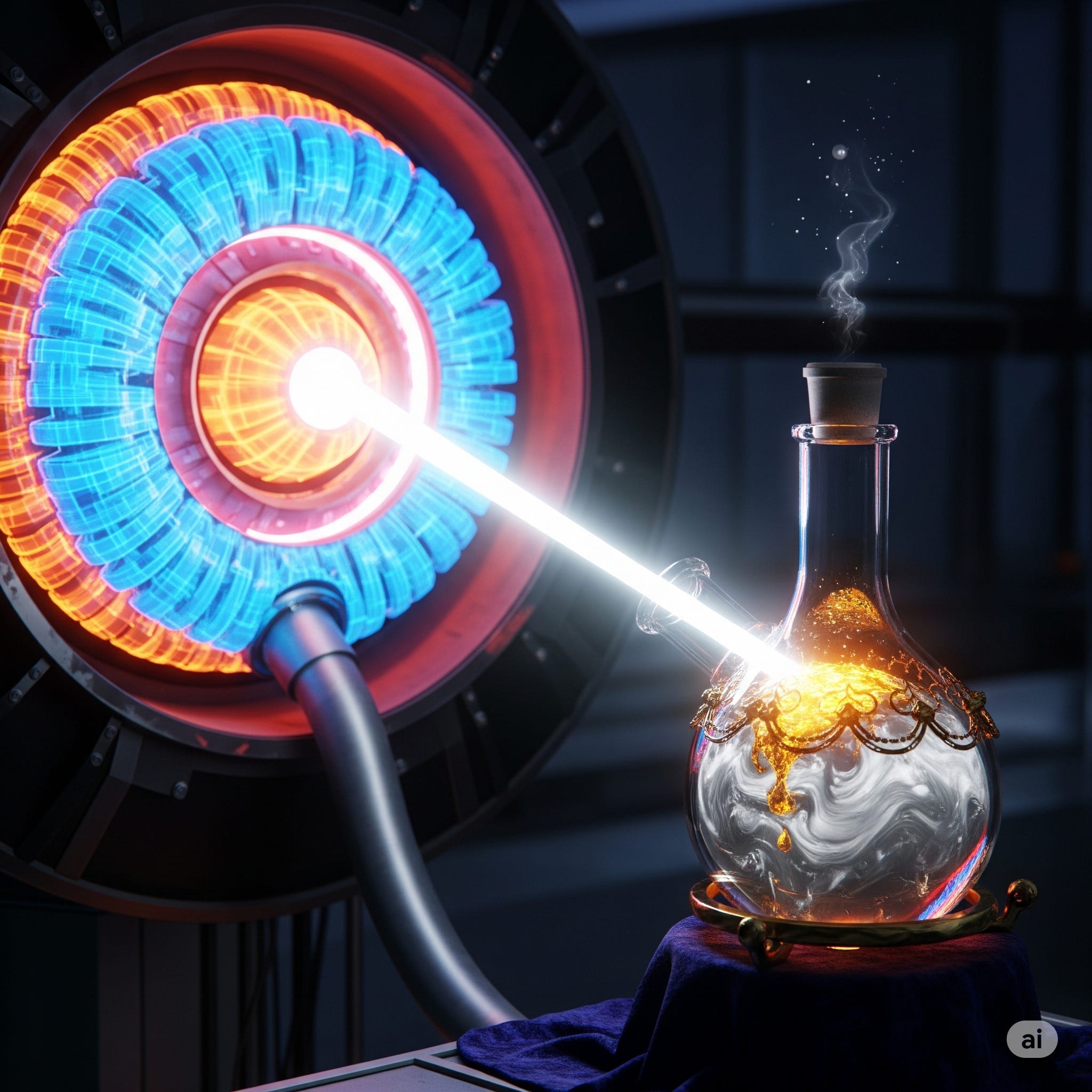
As I was looking through my never ending feed of discovery this golden nugget caught my eye like a miner, panning for gold. Could this be real? Did we just solve the expense of nuclear energy? Decrease the amount of nuclear waste and turn it into gold? Did we just get the keys to manufacturing the door to nature?
Why, yes, it looks that way. A paper published initially on July 17th, 2025 states in the abstract:
A scalable approach for chrysopoeia - the transmutation of base metals into gold - has been pursued for millennia. While there have been small-scale demonstrations in particle accelerators and proposals involving thermal neutron capture, no economically attractive approach has yet been identified. We show a new scalable method to synthesize stable gold ($^{197}$Au) from the abundant mercury isotope $^{198}$Hg using (n, 2n) reactions in a specialized neutron multiplier layer of a fusion blanket. Reactions are driven by fast 14 MeV neutrons provided by a deuterium-tritium fusion plasma, which are uniquely capable of enabling the desired reaction pathway at scale. Crucially, the scheme identified here does not negatively impact electricity production, and is also compatible with the challenging tritium breeding requirements of fusion power plant design because (n, 2n) reactions of $^{198}$Hg drive both transmutation and neutron multiplication. Using neutronics simulations, we demonstrate a tokamak with a blanket configuration that can produce $^{197}$Au at a rate of about 2 t/GWth/yr. Implementation of this concept allows fusion power plants to double the revenue generated by the system, dramatically enhancing the economic viability of fusion energy.
Chrysopoeia: refers to the artificial production of gold, most commonly by the alleged transmutation of base metals such as lead.
Not a word you hear everyday but one that has been discussed, hypothesized and successful in the past, albeit a not so financially viable production. Wikipedia has some excellent history and some great links if you want to get in the weeds further here.
My goal in writing this, was exploring the thoughts that came to mind. Not only was this feasible, there is a real possibility, that this concerns more than just the synthesizing of gold. It may solve some major issues and at the same time raise some implications for our future.
Economic and Practical Impact
What if the most valuable thing a power plant produced wasn't power?
So here are the things I started to explore further. The process doesn’t hinder the production of power. The power plants essentially produce this isotope as a byproduct and the way its done, decays the left over into stable gold. The production rate is high so approximately 2 tonnes of gold per gigawatt of thermal power each year. The current although needs some questions asked is that the gold market is large enough to handle supply being put into the economy. By doing so the almost flat profits of running a power plant turn into doubling there income and therefore lowering the cost of nuclear energy even more.
That being said, there are some hurdles in Mercury isotope separation technology being able to be upscaled to hundreds of tons needed. Also Mercury, you know it is some nasty stuff and its a nuclear reactor so materials need developed to handle the corrosive liquid at high temperatures. Not to mention any safety regulations and protocols that need determined in this process.
Overall, if it works cleaner, cheaper energy with a question still remains about the impact of gold being added into the market. One thing that may actual slow the amount of gold into the market is that it stays radioactive, and takes a little less than 18 years to be safe. You know the less radioactive than a banana scale. The paper argues this isn't just a novelty; it fundamentally changes the business model for fusion energy.
Before I move on I want to point out the entire section of Appendix A, because this isn’t just gold. It’s a new periodic table of possibilities. Things like Palladium, Osmium and Silver. They also mention isotopes for medical and nuclear batteries. Which brought me to the next question.
A New Kind of Manufacturing
Turning mercury into gold. Why stop there?
All the elements we see are made of three building blocks: protons, neutrons, and electrons. The difference between a mercury atom and gold atom is just one proton and few neutrons. What this paper demonstrates is a practical blueprint for a tool, the high energy neutron flux from a fusion reactor, that is powerful enough to reach into the nucleus of an atom and rearrange those fundamental building blocks.
A future where resource scarcity is a thing of the past. Need rare earth elements for your electronics? We can transmute them. Need a specific isotope for a medical procedure or a nuclear battery? We can manufacture it on demand. This technology is the first step toward a future of "industrial synthesis of valuable elements".
This is the kind of discovery that doesn't just create new technology, but forces us to ask new questions about ourselves
“industrial synthesis of valuable elements.”
Ancient Question, Answered
The age old question was, "Is it possible to change one element into another?" For centuries, the answer was a mix of philosophy, chemistry and magic. The old answer was through a mystical catalyst the “Philosopher’s Stone”. The new answer, that “stone” is a massive flux of neutrons with more than 14MeV of energy.
However, it makes the philosophical questions of alchemy more urgent than ever. Alchemists grappled with the nature of value, purity, and humanity's role in creation. By turning transmutation into an industrial process, we are now forced to confront those same questions on a global scale.
What does it mean for society when our most ancient symbol of wealth and permanence can be manufactured in a power plant?
You can visit this link to read the full published paper. https://arxiv.org/abs/2507.13461v2