The canonical edition of this piece lives at shankstrategy.com.
Every day there is another headline trying to grab you by the nervous system.
Not inform you. Not clarify. Not even really persuade you.
Just spike you.
Terror plots. Sleeper cells. Civil war. Economic collapse. Democracy hanging by a thread. Society one bad Tuesday away from open flame.
Sometimes the underlying event is real. Sometimes the risk is worth tracking. But the packaging is almost always doing more than the facts. The facts may be thin. The emotional payload is not.
At some point you have to ask a pretty basic question:
How much of this can people take before they either shut down, stop trusting anything, or just quietly give up on the future?
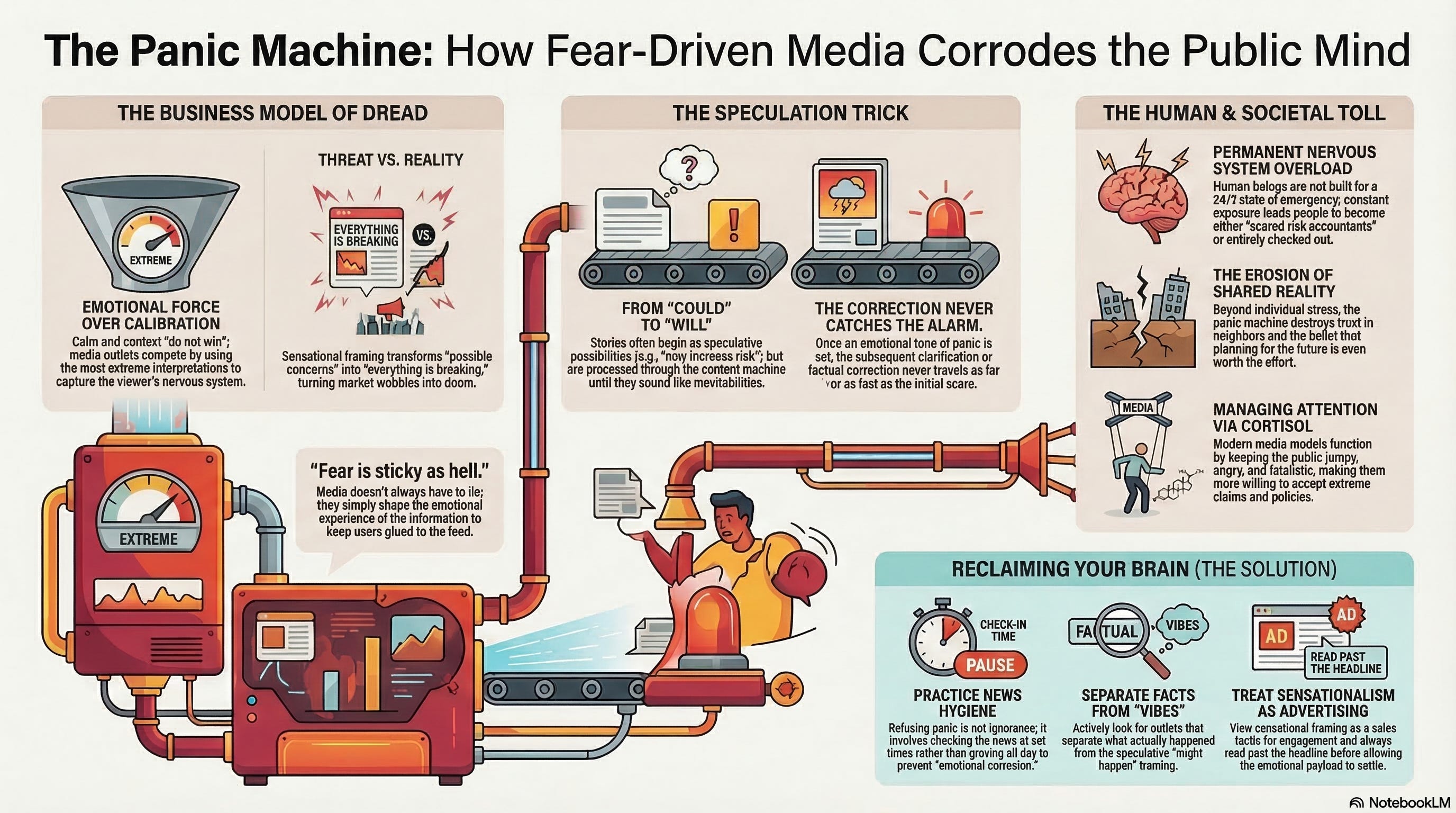
Fear is a business model
Modern media does not just report events. It competes in an attention market that rewards emotional force over calibration.
And calm does not win that game.
Careful headlines do not win.
Context does not win.
“We do not know enough yet” does not win.
What wins is threat.
Big scary framing. Worst case interpretation. Maximum implication. Every story pushed a little closer to the cliff edge because “possible concern” does not hit the same as “everything may be breaking.”
So a missile test becomes regional war vibes.
An arrest becomes hidden cells in your zip code.
A protest becomes the end of the republic.
A market wobble becomes financial doom with a countdown timer.
They do not always have to lie. That is the slick part. They just need to shape your emotional experience of the information. And fear is sticky as hell.
What it does to people
You do not need a clinical manual to see the effect.
If you soak people in fear-heavy headlines long enough, a few things happen.
They start feeling permanently on edge.
They lose the ability to tell the difference between serious threats and speculative noise.
They begin to relate to the future like it is something that happens to them, not something they can influence.
That is bad enough at the individual level. Scale it up and it gets uglier.
You get a culture that is jumpier, angrier, more fatalistic, and easier to manipulate. People become more willing to accept extreme claims, extreme policies, and extreme certainty because they have been trained to feel like the sky is always one loud headline away from falling.
We call it staying informed.
A lot of the time it is just emotional corrosion with a news logo on top.
Speculation keeps getting sold as reality
This is one of the dirtiest tricks in the whole system.
A story starts as possibility.
Could lead to.
May increase the risk of.
Raises concerns about.
Some experts worry.
Then it moves through the content machine and comes out sounding like inevitability.
Will lead to.
Threat growing.
Experts say.
Crisis looming.
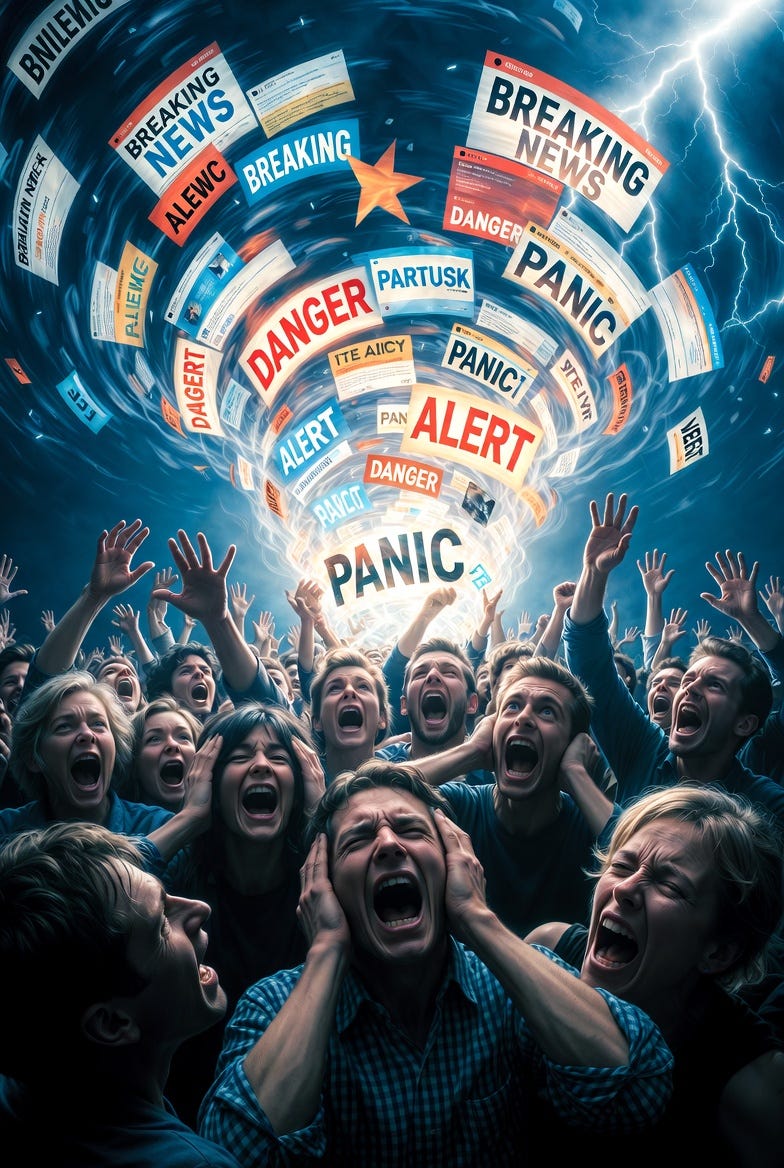
That shift matters. It turns uncertainty into atmosphere. It turns probability into felt reality. By the time it lands in someone’s feed, it no longer reads like a risk assessment. It reads like a weather report from hell.
And once that emotional tone gets set, the correction never travels as far as the alarm did.
That is the game.
Scare first. Clarify later. Maybe.
There is no clean breaking point
This is the uncomfortable part.
There is no big red warning light that flashes when a society has absorbed too much fear propaganda. Nobody announces that we have officially crossed the threshold from informed public to emotionally exhausted herd animal.
It happens slowly.
People get more numb.
More reactive.
More cynical.
More checked out.
Less able to tell signal from spectacle.
Less willing to believe anything can improve.
Trust erodes.
Not just trust in institutions, but trust in neighbors, in shared reality, in the idea that planning for the future is even worth the effort.
That is the real damage.
It is not just that people feel bad. It is that they begin to organize their whole relationship to public life around dread, exhaustion, and anticipatory defeat.
That is a brutal way to run a society.
We were not built for permanent emergency
Human beings are not meant to live in a 24/7 state of incoming doom.
But that is exactly what the media environment keeps trying to manufacture. Constant urgency. Constant escalation. Constant implication that the next update might confirm your darkest suspicion about everything.
And if you consume enough of that, your nervous system does what nervous systems do.
It adapts badly.
It gets fried.
Or numb.
Or both.
Then people either obsessively monitor the feed like scared little risk accountants, or they bail out entirely and stop engaging because it all feels rotten and theatrical.
Neither response is especially healthy. Both are understandable.
Refusing the panic is not ignorance
You do not have to unplug from reality to stop letting the panic machine use your brain as a rental property.
That can mean simple stuff.
Check the news at set times instead of grazing all day.
Prefer outlets that separate what happened from what might happen.
Treat sensational framing like advertising until proven otherwise.
Read past the headline before letting it move into your bloodstream.
That is not denial. That is hygiene. At least in some form.
Real dangers exist. Some things are worth worrying about. Some threats are not exaggerated. But the current system does not just inform people about danger.
It conditions them to live inside it emotionally, whether or not the facts justify that state.
That should bother people more than it does.
The actual point
We need reporting on real risks. We need clear-eyed coverage. We need warning when warning is justified.
But we also need to get more honest about how fear is packaged, amplified, and sold back to us for engagement.
Because if every day feels like one more social collapse trailer, people stop responding like citizens and start responding like cornered animals.
And that has consequences.
A culture can absorb a lot of fear. More than it should.
But not forever.
Eventually people either go numb, g
o crazy, or stop believing in the future altogether.
That seems like a pretty high price to pay just so the headline can perform a little better.
If your entire media model depends on keeping people scared, angry, and glued to the feed, do not pretend you are just informing the public. You are managing attention through cortisol. That may be profitable. It may even be effective. But it is not free, and the bill eventually shows up in the culture.
This is outside my normal wheelhouse. I felt compelled…