

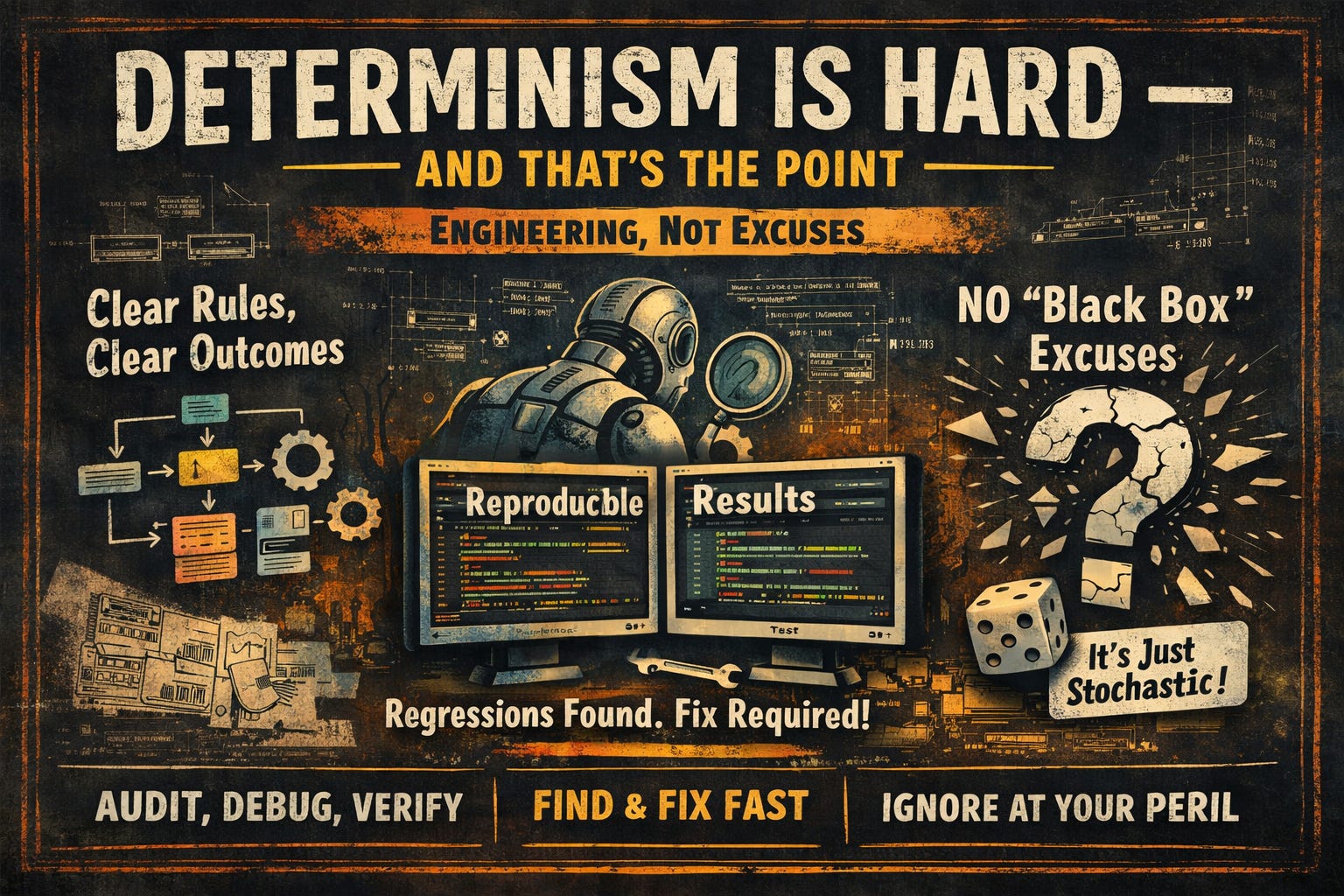
Determinism: The Only Engineering Discipline That Matters When Stakes Are High
In philosophy, determinism is a debate about free will. In software engineering, determinism is often treated as a preference; a stylistic choice for functional programmers or systems architects who like things “tidy.”
Both views are wrong.
Determinism isn’t a preference. It is an engineering discipline. And it is arguably the only one that matters when the stakes are high. It is difficult to achieve because it systematically removes excuses.
That is exactly why it is worth doing.
The Comfort of “Vibes”
The path of least resistance in modern software—especially in the era of probabilistic AI—is to build systems that work “mostly.”
When a nondeterministic system fails, it offers you a seductive escape hatch: “It’s stochastic.” “It was a race condition.” “The model hallucinated.” You can shrug, retry the request, and if it works the second time, you move on. Nondeterminism allows you to hide behind probability, scale, and “vibes.”
Deterministic systems deny you this luxury.
In a deterministic system, if Input A produces Output B today, it must produce Output B tomorrow, next year, and on a different machine. If it produces Output C, you cannot blame the universe. You cannot blame entropy. You have to admit that you missed an invariant.
Determinism forces you to state exactly what the system does, under what conditions, and why. It is a mirror that reflects every gap in your logic.
Auditing vs. Sampling
The distinction between deterministic and nondeterministic systems is the difference between proof and observation.
A nondeterministic agent can only be sampled. You run it 1,000 times, measure the success rate, and hope the distribution holds in production. You are crossing your fingers.
A deterministic agent can be replayed, audited, and diffed.
This is why finance, avionics, and compiler infrastructure are “boring” on purpose.
Finance: If a high-frequency trading algorithm behaves differently during a backtest than it does in live execution (given the same tick data), you go bankrupt.
Avionics: If a flight control system handles a sensor spike differently on Tuesday than it did in the simulator, people die.
Compilers: If clang produced a different binary every time you ran it on the same source code, the entire software industry would collapse.
These fields do not rely on vibes. They rely on regression tests that actually mean something. When a deterministic system breaks, you don’t roll the dice again; you write a test case that reproduces the failure 100% of the time, and you fix it forever.
These disciplines enforce determinism not out of pedantry, but survival. In avionics, DO-178C certification demands reproducible behavior across simulations and hardware—any divergence can ground fleets or worse. In finance, high-frequency trading firms lose millions (or go bankrupt) on microsecond mismatches between backtest and live execution. Compilers like Clang and Rust enforce deterministic builds via flags and tools because nondeterministic binaries break trust: the same source can produce different executables, opening doors to supply-chain attacks like the 2020 SolarWinds breach or the 2024 XZ Utils backdoor. Reproducible builds—where identical source + environment yield bit-identical binaries—have become a cornerstone of software supply-chain security, endorsed by projects like Reproducible-Builds.org and increasingly adopted by distributions like Fedora (which reached ~91% package reproducibility in recent rebuilds of Fedora 42, targeting 99% in upcoming releases). Determinism here isn’t optional; it’s the last line of defense against tampering.
The Hard Truth: The Upfront Tax
If determinism is so superior, why isn’t everything deterministic?
Because it imposes an upfront tax—in design time, explicit modeling, and tooling—but the investment amortizes rapidly.
You cannot hand-wave missing invariants. You cannot rely on implicit state, system clocks, or unseeded random number generators. You have to model time explicitly. You have to mock the universe.
In the early days of a project, this feels like wearing ankle weights. You are spending hours architecting a replayable message bus while your competitors are shipping features that work 90% of the time.
The Compounding Payoff
However, as the system grows, the curves cross.
The price of nondeterminism compounds brutally. Industry reports estimate poor software quality—including elusive, hard-to-reproduce bugs—costs the U.S. economy alone at least $2.41 trillion annually (Consortium for Information & Software Quality, 2022 report), with accumulated technical debt around $1.52 trillion and expectations of continued rise amid growing complexity and supply-chain risks. Heisenbugs—intermittent failures that vanish under observation (race conditions, timing-dependent errors)—are especially vicious in distributed systems. Debugging them often takes days to weeks of log-diving and production forensics, compared to minutes in a deterministic replay. Studies on distributed debugging highlight that these bugs thrive in concurrency and asynchrony, where the observer effect (adding logs or breakpoints) alters timing and masks the issue—turning weeks of “vibes” into a single, diffable reproduction.
In a “vibes-based” system, reliability creates a game of Whack-a-Mole. Every fix introduces a new race condition. Debugging is a forensic nightmare.
In a deterministic system, reliability compounds.
Debugging time collapses: You don’t guess; you replay. The “Heisenbug” that happens once in a million requests becomes a static artifact you can step through in a debugger.
Trust boundaries solidify: You know exactly what data affects the system state.
Refactoring becomes safe: If you change the code and the output remains bit-perfectly identical for a recorded set of inputs, you know you haven’t broken anything.
Debugging time drops from “weeks of vibes” to “one diff.”
The Functional Core and the Dirty Edge
The most common counterargument is: “The world isn’t deterministic.”
Users are unpredictable. Sensors are noisy. Markets are chaotic. LLMs are probabilistic engines.
+1
This is true, but it is a categorization error. The mistake is pretending that nondeterministic inputs justify a nondeterministic core.
The goal is not to control the weather; the goal is to control how your system processes the weather. You push the chaos to the edges (the “Imperative Shell”) and keep the logic pure (the “Functional Core”).
Enter the Functional Core, Imperative Shell pattern (popularized by Gary Bernhardt in his talks “Boundaries” and “Functional Core, Imperative Shell”): Push nondeterminism to the edges—the “imperative shell” that handles I/O, concurrency, randomness, and external state—while keeping the business logic pure, deterministic, and testable in the “functional core.”
In practice:
Record incoming user actions, sensor readings, or LLM outputs (with seeds/timestamps) as immutable events.
Feed those fixed inputs into a deterministic core that computes the response.
Let the shell apply the result (send email, update UI, commit trade).
This turns probabilistic AI into a deterministic processor: the model may hallucinate, but given the same prompt + seed + temperature, the output is replayable forever. Hybrid systems (e.g., rule engines for compliance wrapped around LLMs for creativity) are converging on this in enterprise AI—deterministic guardrails ensure audit trails while allowing adaptive edges.
Conclusion
Determinism doesn’t make systems rigid. It makes them understandable.
The discomfort engineers feel when forced to build deterministically is not the pain of restriction; it is the pain of clarity. Determinism makes ignorance visible. It forces you to look at the gaps in your understanding and fill them.
That is why it feels uncomfortable. And that is why serious systems eventually converge on it.
In an era of accelerating supply-chain attacks and regulatory scrutiny (e.g., SBOM mandates), determinism isn’t luxury—it’s infrastructure.
Nondeterminism has valid roles—simulations, creative generation, Monte Carlo methods—but when correctness, auditability, or safety are non-negotiable, determinism is the discipline that wins.